6/30/10

summer harvest photos... more to come


FRESH ALMONDS are quite ephemeral, appearing at marketplaces in France for only 2 - 3 weeks in July - August. Dressed in their furry green cloak, they are traditionally cracked open and eaten for dessert.

The juicy, deep-flavored BLACK CURRENT is a mouth-watering temptation at marketplaces in July and August. Gather up a basketful and make some confiture. Or stir up a summer Black Current-Plum Tart (with Spelt pie crust).

CHANTERELLES (called girolles in French) pop up out of the ground from June - October. They have a light earthy flavor and are somewhat fragile when it comes sto cooking them: best to sautée them slowly, high heat tends to tun them hard. Great satutéed in an omelette, or marintaed raw in an herb-flavored olive oil.

One of summer's sturdy, faithful vegetables is ZUCCHINI. They get piled up on vegetables stands starting in July and on through November. I recently marinted them, sliced thin, in olive oil, lemon juice and zest, nd mint and bay leaves... Recipe and photo forthcoming.

This tiny Beurré Giffard PEAR, an early variety discovered in 1825 and mainly found in organic circles, brightens up the summer fruit landscape with its intense green coloring and is harvested from late July and on through August. Great for a sweet, juicy snack...

The CHARENTAIS is France's star MELON; so beloved for its succulent flavor and meaty texture it is often served at the beginning of a meal, with perhaps a bit of Porto or reduced balsamic vinegar drizzled over it. You'll find it ever in attendance at the marketplace from July through September.

6/28/10

the CONSCIOUS PALATE Newsletter - JULY 2010

Summer has finally arrived in Paris, and it descended quite abruptly. No warning... from a cool 75 ˚ to 90 ˚ in the space of a day. Mylar emergency blankets hang from my windows keeping the screeching sunlight at bay while a fan breaths heavily upon me a cooler air, or at least a circulating air. And it looks like these caniculaire (scorching) temperatures will persist for some days... I creep out in the morning and then again as the sun angles low... the rest of the day I hunker down at home, if possible.
Giving cooking classes in this weather demands a change of venue... Much less oven activity to be sure and lots of fresh salads and deserts. But since my clients often ask to learn my Roasted Radish recipe, I nonetheless have to light up the oven for a short stint... 2 - 3 minutes of roasting and the leaves are crystallized to a bright green transparency, the radishes still crunchy. Inevitably I always find myself with fresh radishes galore left over and, inspired by the heat, I came up with this Radish Smoothie... quite refreshing and simple as can be. Recipes below..
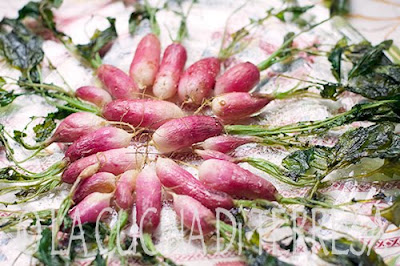
ROASTED WHITE-TIPPED RADISHES
Very fresh red-white radishes (make as many as you wish)
Extra-virgin olive oil
Unrefined sea salt and freshly ground WHITE pepper

— Preheat oven to 400 ˚F.
— Carefully wash radishes without removing their tops or thin roots. Gently spin in a lettuce spinner then spread out to dry. If the radishes are large, make a cut down the middle from the just below the top of the bulb through the root (the radish will fan out a bit but still be intact). Place 10 or so in a large bowl, drizzle with olive oil and toss to lightly to coat. Make sure the leaves are coated with a thin layer of oil. Arrange them on a large cookie sheet a short distance from each other, alternating the position of radish and leaf and making sure the leaves are not folded over and that none of the leaves overlap — if they do they won’t crystallize.
—Bake in the oven, on the top rack, for 2 - 3 minutes, or until the leaves have turned transparent and crispy but have not yet begun to brown. Remove from the oven and immediately season generously with unrefined sea salt and a drop of olive oil. If you do a second batch, the baking sheet will be hot and you’ll have to be careful as you position them to keep the leaves from folding under, as they will begin to soften from the heat. And they will roast more rapidly the second time around, so check them after 2 minutes.
— Arrange them on a serving plate. Garnish with freshly ground WHITE pepper.
— Eat the leaves and bulb together — in one fell swoop — to get the full experience of the different textures and flavors (see photo below).

WHITE-TIPPED RADISH SMOOTHIE - serves 4
500 gr red and white radishes (tops removed), remove from refrigerator just before using
200 ml cold mineral water
100 gr goat’s milk yogurt
Squeeze of fresh lemon juice
4 - 5 fresh mint leaves
Unrefined sea salt and freshly ground WHITE pepper

Cut the radishes in half. Place them in a blender along with the goat's milk yogurt and half of the cold mineral water. Begin blending on low speed and as the radishes start to purée turn to high speed. Add the remaining water, mint leaves, and lemon juice, and blend for 1 minute. Add more water and/or yogurt if too thick, or to your taste. Season with a generous pinch of unrefined sea salt and a few twists of the WHITE pepper grinder. Blend rapidly and check the seasoning. Add more salt if needed. Set in the refrigerator for 15 minutes. Pour into glasses and garnish with a mint leaf or two and a twist of WHITE pepper. Drink nicely chilled.

6/22/10

late SPRING harvest photos

I wait for BABY TURNIPS with impatience as spring comes around the corner. The reason being is the green tops that crown them. Spring is the season for a flourish of robust, minerally leafy greens, from beets greens to dandelion leaves, sorrel to young red radicchio. First wilted, either alone or as a mélange, then sautéed with a bit of garlic and pinch of peperoncino. Seasoned with grey salt, a pinch of lemon zest and a few drops of fresh lemon juice... Sublime, and oh so nutritious. They burst forth from mid-March through mid-July. Do keep an eye out for them.

SPRING SHALLOTS are yet another species of the Allium genus, which includes onions of every shape and color, as well as garlic. I spot them on vegetable stands during the months of April, May and June. I love to roast the delicate bulbs and serve them with other roasted spring vegetables over a wonderful rustic polenta Taregna (buckwheat polenta), a traditional recipe from Valtellina in Italy's Lombardia region.

SPINACH, though ever present — winter, spring, summer, and fall — has that special quality of youth when, in spring, it reaches for the sun. It is harvested in bunches, cut just above the roots, and offers a fresh tang to any dish.

The famous The MENTON LEMON boasts its own festival in the town of Menton down along the Côte d'Azur near the Italian border, after which it is named, from February 18 to March 9. Available from mid-February through June, they are larger and sweeter than our common lemon.

I find these wonderful spring heads of RED CABBAGE at the marketplace in April, May and even June. I slice it up into a fine chiffonade (using a mandolin), add some diced apple and Sultana raisins, and dress it with a homemade mint mayonnaise.

CAULIFLOWER — from that Brassica oleracea tribe! — is harvested from April to June and displayed on vegetable stands here in Paris as fresh young, unblemished heads definitely worth being invited into the crowd of raw vegetables in a pinzimonio and sensually dipped into unrefined-sea-salt and freshly-ground-pepper seasoned new-harvest extra-virgin olive oil (what a mouthful...). Being that cauliflowr is — as are most if not all Brassica oleracea plants — a cool season vegetable, it is also harvested from September to November... though maybe not as tender as a spring head it is warmly soothing in a pipping hot creamy soup.

PEONIES... what is there to say but that they are a most exquisite flower that blooms in May, and no sooner its petals open and offering its gentle scent, then they are gone.

The colorful BORLOTTI or Cranberry bean and the riveting green FAVA or broad bean in their plump fresh pods are ready for harvest from mid-spring through mid-summer. Both pulses are more than worth the time and patience required to release them from their curious integuments. Gather together a friend or two and sit down under the shade of an apple tree or awning and spin a few tales as you shuck them one by one. (Recipes forthcoming...)

The arrival of the sweet SWEET PEA at marketplaces from May through July is always festive. As for me, I shuck them with delight over and over in my kitchen for weeks on end and eat them in salads, buckwheat crepes, and the succulent traditional Risi e Bisi rice dish that dates back to the Republic of Venice.

SPRING harvest: ASPARAGUS (in exremis)

Good ol' green ASPARAGUS stalks are always bundled together and sold as une botte (a bunch) at marketplaces here in Paris from April to June (there are still a few days left to grab a bunch, toss them with a bit of olive oil, lightly roast them in a hot oven for just a few of minutes then season them with fleur de sel as you slide them out of the oven. When cool, just dip them in some homemade aioli...
Now I say good ol' because in France it is white asparagus that reigns supreme — funny this fascination with "torturing" certain vegetables (leeks, Belgian endive, radicchio rosso di Treviso tardivo , asparagus) only to then venerate them. By torturing I mean depriving them of any sunlight (no, white asparagus is not a variety in and of itself), heaping mounds of sand up and over each stalk from the moment it sprouts till the time it is hewn down. Merciless, I'd say! In this way no chlorophyl develops — God forbid — giving the normally rotund white stalks a supposedly milder flavor.

6/21/10

Seasonal harvest - the SOLSTICE yeah! - 21 June 2010


I remember the old APRICOT tree in my Aunt Bee's garden in suburban LA back in the '60s and '70s, its boughs laden with plump juicy fruit come mid-June. How majestically it reigned in her backyard, along with a massive, beautifully melancholic weeping willow. Approaching it with awe I'd pick a pulpy apricot, crush it in my mouth and feel a tipsy sensation as its honeyed juice inundated my taste buds and ran like a swollen tributary to the back of my tongue and down. Apricots are to this day one of my most favorite fruits (when farm grown and picked mature) - perhaps surpassed only by blueberries — hmmm, come to think of it, the 2 actually make quite a tandem... So here it is summer SOLSTICE - yeah!! - and I'm celebrating it with at least a handful of apricots... Gotta enjoy them while they're around... come the beginning of August they'll all but be gone.

6/18/10

Seasonal Harvest - June 18, 2010


WHITE-TIPPED RADISHES — from that lovely and sulfurous Cruciferous family. Though available year around, radishes are a cooler weather vegetable and thus sweeter in spring and autumn, their leaves ever so more tender. In the simmering days of summer they become woody and lose all their joy. And those unblemished green tops... 'tis a shame to throw them away; they make for a great addition to salads, can be transformed into a wonderful pesto, or lightly wilted with a mixture of other baby greens. Besides they're an excellent source of Vitamin C and calcium (perhaps 6 times more content than the actual radish). And to think that we mainly grew up watching our mothers throw them away. Of course, if you're going to use the leaves, I'd suggest buying them grown organically, biodynamically, sustainably.... Better yet, grow them yourself — even on your windowsill.

WATERCRESS is one of the earliest known leafy vegetables eaten by humans. A quick growing cool-weather vegetable, it flourishes in spring and autumn. And it is quite an amazing source of calcium, iron, folic acid...

RED SCALLIONS, which are the early shoots of red onions, have begun to crop up at the marketplaces here in Paris. They arrive early April and sometime in June they'll disappear. But in the meantime, you can enjoy them in salads, pasta dishes, and...

Young bunches of BLETTE leaves are out and about this spring. The blette plant is kin to the Chenopodiaceae (or Goosefoot) family along with beets, spinach, amaranth and quinoa, It was cultivated in the European Mediterranean as far back as Babylon and ancient Rome. It became popualr in France in the Middle Ages with many a recipe honoring it. Depending on the variety, its taste and texture recall that of Swiss chard or collards. The blette pictured here is an early French variety whose leaves are small and somewhat thick and more collards in most ways. The variety praised by Italians, whose leaves can achieve elephantine proportions, has a surprisingly silky texture and thin, supple leaves, and brings more to mind Swiss chard. If growing it in you garden, it can be harvested from July to October. The larger leafy blette has white ribs which can comprise up to a third even a half of its size, but they are rarely discarded. In fact they're quite prized and spun into succulent gratins and savory tarts in France and Italy alike. One of my favorite ways to use the colossal leaves is in the savory tart, erbazzone, that hails from Emilia-Romagna.

The prized GARIGUETTE is a treat to behold in your mouth. This early variety of strawberry is picked from mid-April to mid-June and its presence at the marketplace exhales spring in all her glory.

This young bulb of FENNEL hails from Sicily where the more clement temperatures allow for winter growth. In its native region (southern Europe and the Mediterranean) it is normally planted in late spring or early summer for harvesting in autumn and then again in spring. Of course fennel is available in summer and winter, but oh how stringy and cantankerous it is, as fennel is not one persuaded by summer's warmth or winter's chill.

RHUBARB was known for its curative properties some 4500 years ago in places such as China and southern Russia, but it wasn't until the 18th century that people took to celebrating it in dishes, both savory and sweet. The beautiful red stalks are available from the end of April through June and they make wonderful compote, pies, chutney...

WILD FENNEL grows prolifically throughout spring. It has often been considered a nasty weed, spreading out enthusiastically on hill and dale. You can easily forage for it on a sunny country lane or rolling hill. Kindly cut off the younger, more tender stalks; as they age they become fibrous. The bright green feathery fronds are wonderful added raw to salads. Sicilians cook frond and stalk then sculpt them into the most earthy wild fennel cakes.

VIOLET ARTICHOKES are cultivated all around the Mediterranean region. Certain Italian varieties are delectable eaten raw, very thinly sliced and served with freshly squeezed lemon juice and a good, spicy extra-virgin olive oil. They are harvested from March to May (often available again in fall), and of course are heavenly in risotto or frittata.

SORREL is a perennial plant whose young leaves can already be picked in early spring and then on through fall. A most hardy plant that I left on my windowsill through Paris's last expressive winters, waking up in the morning to find it cloaked with snow and gleaming. Mix the baby leaves with all the other fine young shoots to ad a nice tart layer to your salad. And if the Northern winds persist even in May (!) ... gather up younger and older leaves and swirl them into a velvety soup.

Is there any green as exquisitely luscious as the BEET GREEN? Lightly wilted then swiftly sautéed with a pinch of chopped garlic (sprout removed), seasoned with unrefined sea salt and freshly ground pepper and, just before heaping onto a plate, christened with a pearl or two of fresh lemon juice. Heaven is just around the corner! Don't let anyone cut off those tops ever again! Not to mention they're chocked full of vitamins and minerals. From mid-spring to at least mid-summer they spread their lofty leaves out on vendors' stands at markets here in Paris, waiting to be gathered up into your arms.

Fresh ROSE GARLIC: fat, round, and full of delicate flavor. You can find it at the marché from the end of May through September. All young fresh allums (onion, shallot, garlic) are kindly digestible, so don't deprive yourself of their savor. Chop fresh garlic (first remove the exterior leaves, until you get to its firm heart) and sprinkle it on a salad, or toss the cloves with a drizzle of extra-virgin olive oil and roast in a hot oven, on the top rack, for 10 minutes or so. Great with roasted beets.

NEW ONIONS [oignons nouveax] as they're called in France are available from April to July. I love to douse them with extra-virgin olive oil, wrap the green tops in parchment paper then roast them in a hot oven, on the top rack, for 5 - 10 minutes. They make a beautifully colorful garnish to any vegetable dish and are generously sweet in the mouth.

TOMATOES, TOMAhTOES. They've just begin to appear at one of my favorite marketplace vendors at the Aligre marché in Paris... all the way from Sicily — and still green. (The red ones pictured above were as green when I bought them as the shier one hiding behind them until they ripend into their now robust crimson robe.) I have to tell you that when I bite into my first tomato of the season, a clamorous joy invades me. I eat mounds and mounds of them until there are no more to pluck from the vines, knowing I'll have to go without their enthusiastic presence and vigor through the long winter months. But from May to October it's tomato time!

WILD ASPARAGUS, delicate, wispy things you can gather in the woods and hills from mid-March - mid-February (depending how far south you are) through mid-April. But I would be stretching the truth if I let you think that I'd been out with my basket picking them not far from a quaint village setting... Alas, they are also now grown commercially and I picked these up at the marketplace the other day. It was an adventure of sorts nonetheless, as I steered my bike through the teeming streets of Paris and back home again with them in tow. Seems the most mouth-watering way to prepare them is lightly cooked in a splash of water then added to a frothy omelette.
I'm a bit late in getting onto my Seasonal Harvest list this spring variety of Brassica oleracea: CHOU POINTU (pointed cabbage), which naturally "points" its conical head up at you from vegetable stands throughout France during the months of April, May and June. Smooth, exuberantly large outer leaves spiral down into a tight-knit cone of wonderfully refined texture and flavor. The German heirloom cabbage Spitzkohl is quite similar (if not the same, but for the fact that it's left to grow to surprisingly large proportions) and is commonly used in the making of sauerkraut. Try the raw inner leaves cut into a fine chiffonade, tossed with other seasonal vegetables and herbs, and seasoned with extra-virgin olive oil and fresh lemon juice.