
Back from the Loire Valley after such a generous stretch of days it truly feels that all the city grit has been rinsed from my cells… The cats rolled and lolled, leapt and stretched out languorously in a mostly gentle sun, the air somewhat heavy — holding restless, stormy thoughts.
I had planned on making headway on my recipe book — I’ve been less than productive recently — but in the end progress continued ploddingly in the countryside where the earth seemed to pull me down to slow rotations. Not to mention the numerous short trips to the caves (cellars) of natural winemakers, along the Cher River in la Touraine, whose vin nature I so love and from whose wine tastings — each seeming to carry on for hours as we got to talking sipping walking through grape vines tasting ripened (ou presque) Sauvignon, Gamay, Cabernet — I came home ready to simply dream or nap.
I revisited Noella Morantin, Joel Courtault, Clos Roche Blanche, and discovered the wines of Bruno Allion, Pascale Potaire, and Christophe Foucher. (Most of these folks have no websites, but wineterroirs.com has visited some and has good info and photos.) All absolute artisans – wizards of a sort – passionately committed to producing “honest, drinkable wines” as les Vins du coin website so simply states.
les Vins du coin is a regional association of winemakers in the Touraine “who all are aware that the earth does not belong to us and that to sustain their craft they must treat it with respect. They are all prepared to take risks in order to produce good grapes and accompany them in the cellar so that they reflect where and when they were grown. Good grapes transformed into honest, drinkable wines. Wines you can drink without waking up with a clouded head.”
And “accompany” is exactly what they do: adding nothing, taking nothing away, and refraining from manipulations of any kind while tending to their vineyards in a sustainably, biodynamically manner.
Christophe Foucher of La Lunotte put it succinctly: it's about increasingly allowing his wine to express its unique personality.
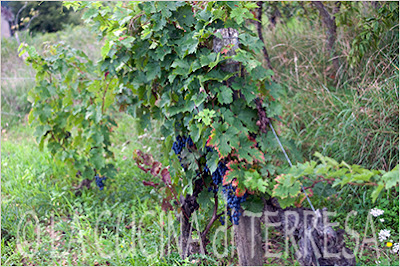
Here’s a striking photo I took on a walk through Joel Courtault’s vineyards…as he pointed out one of the visibly startling differences between natural and conventional wine growing practices (between the rows of his neighbor’s vines there was a robust spraying of weed killer)!

Lovely "good" grapes...
 By the way, this is a good website if you're interested in learning more about French vin nature: morethanorganic “dedicated to promoting French natural wine in the English–speaking world.”
As for the unusual weather this year – estival in spring, rain and brooding skies in summer — seems it was a perfect combination for the profusion of wild mushrooms in the region, particularly one called oronge (Cesar's mushroom). Quite a highly regarded edible wild one, and which I had the pleasure of discovering — its vibrant orange/red caps — and savoring — its absolute subtle flavor — thanks to Catherine at Clos Roche Blanche who bequeathed to me a couple, instructing me to simply sauté them in a bit of good olive oil and season with a pinch of sea salt and some freshly ground pepper. Yes, très bon!


1 massive zucchini
— You'll need a bit of cooked garbanzo beans — please don't use canned ones: soak some beans, say 50 gr / 1.5 oz, over night (or in boiling water for 1 - 2 hours). Discard the soaking water. Cover with fresh water by 2 inches (depending on how old your beans are, they'll take longer to cook and thus will need more water). Add 1 - 2 fresh bay leaves and a whole clove of garlic. Cover and bring to a boil over medium heat. Reduce to medium-low and cook until al dente... mine cooked in 30 minutes. Once they start to soften you can add some coarse sea salt to taste.
— Cut your ginormous zucchini into 4 - 6 thick rounds (mine weighed 1 kg / 2 lbs) and roast on one flat side on a lightly oiled baking dish in an oven preheated to 200˚C (400 ˚F) for 25 - 20 minutes, depending on size. Needs to be a bit al dente, so check with a sharp knife... if it enters with a bit of resistance, you're probably there. Scrape out inner pulp and seeds and set aside to drain in a strainer. Sprinkle a bit of sea salt in each round.
— Bring a large covered pan of water to a boil and remove from the heat. Score your tomatoes, 400 - 500 gr / 1 lb, and blanch for 45 seconds in the water. Peel then seed them over a bowl to catch any juice. Cut into bite-sized dice, place in a strainer and drain all juice over the same bowl. Toss with a bit of sea salt. (Don't throw the skins, seeds and juice away. Pass through a food mill, put in the fridge and use for another dish the following day.)
— Freshly grate a generous amount Parmigiano Reggiano and/or Sardo Pecorino.
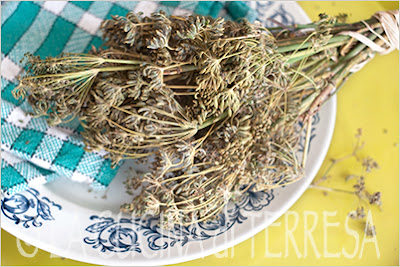
— In the meantime, wash 300 - 400 gr / 3/4 lb of Swiss chard. Cut off the ribs then using only the upper part of the ribs, cut into small dice. Chop the Swiss chard very coarsely. Just wilt in a large covered skillet over medium-high heat, with a couple splashes of water, for 3 - 4 minutes. Drain and set aside to cool while you sauté in a drizzle of olive oil in the same skillet. Add first the ribs and sauté for a couple of minutes, then add 1 - 2 garlic cloves, coarsely chopped, and sauté for another minute or so. Squeeze the excess water out of the Swiss chard leaves. Add to the garlic and ribs, and sauté for another 3 - 4 of minutes. Turn off the heat and add a pinch or two of sea salt to taste, a couple three squeezes of fresh lemon juice and the zest of half a lemon. Stir and transfer to a bowl. Add the drained zucchini scrapings and seeds, the tomatoes, garbanzo beans, a couple small handfuls of grated Parmigiano, and a good pinch of wild fennel seeds (photo above) — I'd gathered some, quite dry on the vine, a few days before, and love their parfum. Not sure "un-wild" fennel seeds would offer the same subtle fragrance (as with lavender, as Giuseppina pointed out to me down in the Luberon, the cultivated stuff has long since lost its "wild" subtlety). There's still time this year to gather some up... simply take a walk out along a country trail just about anywhere where summer is coming to an end and wild fennel grows, and you could surely pick yourself a nice bouquet, take them home, and let them hang somewhere dark until completely dry - if not already. (I'll do a test and get back to you on the cultivated fennel seeds, or you try it and get back to me...)
— Season with sea salt and freshly ground pepper to taste.
— If you have any roasted hazelnuts around, chop them coarsely. Otherwise roast a handful in the oven at 160 ˚C (325 ˚F) for about 15 minutes. Wrap in a linen towel and let steam for a few minutes. Rub the towel together to remove the skins then chop coarsely.
— Heat up your broiler.
— Now take your stuffing and generously fill in the center of each zucchini round, packing it down and letting it overflow on top. Sprinkle with some roasted hazelnuts then a nice thick blanket of Parmigiano. Place under the broiler and brown the cheese, 5 - 7 minutes.
This is more a warm than a "hot" dish... If you prefer steam coming off your main plate, try this as an appetizer.
As for wine: I drank it with Joel Courtault's 2008 Epidote (100% Sauvignon Blanc). Would've been lovely with Hervé Villemade's La Bodice (Sauvignon/Chardonnay blend), as well. Or Bruno Allion's Surin (100% Sauvignon Blanc). The white wine has to have that mineral content, as only vin nature has, and not be too dry. Some importers and merchants of natural wines from France are : Louis Dressner in New York, Triage in Seattle, Terroir SF and Arlequin Wine Merchant in San Francisco. More on French vin nature and paring with vegetable dishes... coming soon.
And finally this is Dominique... I fell in love with him in the Loire.


As for the unusual weather this year – estival in spring, rain and brooding skies in summer — seems it was a perfect combination for the profusion of wild mushrooms in the region, particularly one called oronge (Cesar's mushroom). Quite a highly regarded edible wild one, and which I had the pleasure of discovering — its vibrant orange/red caps — and savoring — its absolute subtle flavor — thanks to Catherine at Clos Roche Blanche who bequeathed to me a couple, instructing me to simply sauté them in a bit of good olive oil and season with a pinch of sea salt and some freshly ground pepper. Yes, très bon!


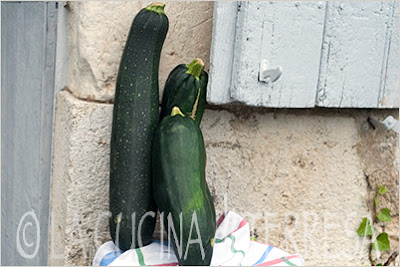
And as I was leaving Bruno Allion's Domaine de Pontcher, after one of those lingering wine tastings, he grabbed a couple freshly picked plump overgrown zucchini from the back of his truck and handed them to me, urging me to take them home and cook ‘em up. Their tender pulp was worth discovering, he said (I’d always imagined it tough). And they were splendid!


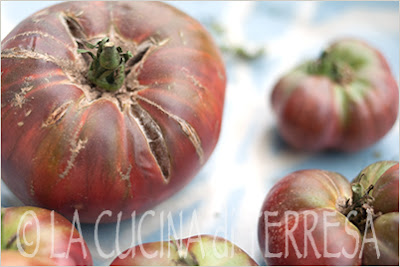
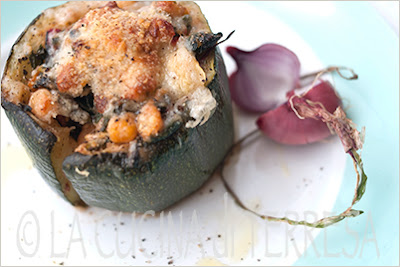
After roasting and stuffing them (with the tomatoes above), I sat down with a recently bottled Epidote 2008 (100% Sauvignon blanc) from Joel Courtault, and savored the union of flavors that transpired in my mouth. Below is a draft recipe, more a suggestion or guide… any combination and/or quantity of seasonal vegetables, beans, grains, herbs would give applause.

STUFFED "GINORMOUS" ZUCCHINI
= late summer, early fall
1 massive zucchini
Real fresh sweet tomatoes (in season)
Multicolored Swiss chard leaves (you can keep some of the rib)
Garbanzo beans
Garlic
Lemon juice and zest
Wild fennel seed (fresh or dried)
Parmigiano Reggiano and/or Sardo Pecorino
Extra virgin olive oil
Roasted hazelnuts
Unrefined sea salt and freshly ground pepper
— You'll need a bit of cooked garbanzo beans — please don't use canned ones: soak some beans, say 50 gr / 1.5 oz, over night (or in boiling water for 1 - 2 hours). Discard the soaking water. Cover with fresh water by 2 inches (depending on how old your beans are, they'll take longer to cook and thus will need more water). Add 1 - 2 fresh bay leaves and a whole clove of garlic. Cover and bring to a boil over medium heat. Reduce to medium-low and cook until al dente... mine cooked in 30 minutes. Once they start to soften you can add some coarse sea salt to taste.
— Cut your ginormous zucchini into 4 - 6 thick rounds (mine weighed 1 kg / 2 lbs) and roast on one flat side on a lightly oiled baking dish in an oven preheated to 200˚C (400 ˚F) for 25 - 20 minutes, depending on size. Needs to be a bit al dente, so check with a sharp knife... if it enters with a bit of resistance, you're probably there. Scrape out inner pulp and seeds and set aside to drain in a strainer. Sprinkle a bit of sea salt in each round.
— Bring a large covered pan of water to a boil and remove from the heat. Score your tomatoes, 400 - 500 gr / 1 lb, and blanch for 45 seconds in the water. Peel then seed them over a bowl to catch any juice. Cut into bite-sized dice, place in a strainer and drain all juice over the same bowl. Toss with a bit of sea salt. (Don't throw the skins, seeds and juice away. Pass through a food mill, put in the fridge and use for another dish the following day.)
— Freshly grate a generous amount Parmigiano Reggiano and/or Sardo Pecorino.
— In the meantime, wash 300 - 400 gr / 3/4 lb of Swiss chard. Cut off the ribs then using only the upper part of the ribs, cut into small dice. Chop the Swiss chard very coarsely. Just wilt in a large covered skillet over medium-high heat, with a couple splashes of water, for 3 - 4 minutes. Drain and set aside to cool while you sauté in a drizzle of olive oil in the same skillet. Add first the ribs and sauté for a couple of minutes, then add 1 - 2 garlic cloves, coarsely chopped, and sauté for another minute or so. Squeeze the excess water out of the Swiss chard leaves. Add to the garlic and ribs, and sauté for another 3 - 4 of minutes. Turn off the heat and add a pinch or two of sea salt to taste, a couple three squeezes of fresh lemon juice and the zest of half a lemon. Stir and transfer to a bowl. Add the drained zucchini scrapings and seeds, the tomatoes, garbanzo beans, a couple small handfuls of grated Parmigiano, and a good pinch of wild fennel seeds (photo above) — I'd gathered some, quite dry on the vine, a few days before, and love their parfum. Not sure "un-wild" fennel seeds would offer the same subtle fragrance (as with lavender, as Giuseppina pointed out to me down in the Luberon, the cultivated stuff has long since lost its "wild" subtlety). There's still time this year to gather some up... simply take a walk out along a country trail just about anywhere where summer is coming to an end and wild fennel grows, and you could surely pick yourself a nice bouquet, take them home, and let them hang somewhere dark until completely dry - if not already. (I'll do a test and get back to you on the cultivated fennel seeds, or you try it and get back to me...)
— Season with sea salt and freshly ground pepper to taste.
— If you have any roasted hazelnuts around, chop them coarsely. Otherwise roast a handful in the oven at 160 ˚C (325 ˚F) for about 15 minutes. Wrap in a linen towel and let steam for a few minutes. Rub the towel together to remove the skins then chop coarsely.
— Heat up your broiler.
— Now take your stuffing and generously fill in the center of each zucchini round, packing it down and letting it overflow on top. Sprinkle with some roasted hazelnuts then a nice thick blanket of Parmigiano. Place under the broiler and brown the cheese, 5 - 7 minutes.
This is more a warm than a "hot" dish... If you prefer steam coming off your main plate, try this as an appetizer.
As for wine: I drank it with Joel Courtault's 2008 Epidote (100% Sauvignon Blanc). Would've been lovely with Hervé Villemade's La Bodice (Sauvignon/Chardonnay blend), as well. Or Bruno Allion's Surin (100% Sauvignon Blanc). The white wine has to have that mineral content, as only vin nature has, and not be too dry. Some importers and merchants of natural wines from France are : Louis Dressner in New York, Triage in Seattle, Terroir SF and Arlequin Wine Merchant in San Francisco. More on French vin nature and paring with vegetable dishes... coming soon.
And finally this is Dominique... I fell in love with him in the Loire.


